Agencies
 Services
15588 History Lane
Petersburg, IL
217/632-4000
Open: Visitor Center & Village
March-October, Tuesday-Saturday, 9 a.m. – 5 p.m.
November-March, Tuesday-Saturday, 9 a.m. - 4 p.m.
Closed Thanksgiving Day, Christmas Day & New Year's Day.
There is camping at this site. Online reservations for camp sites and shelters can be made through the ExploreMoreIL™ website and paid for by Visa, MasterCard, or Discover.
Teachers in Illinois schools (grades prekindergarten through 12) can apply for grant funds to visit this site on a field trip with their students. Click here for the details.
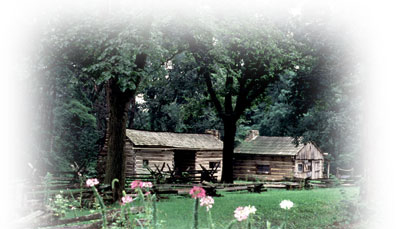
Lincoln's New Salem State Historic Site, operated by the Illinois Department of Natural Resources, preserves the site of the New Salem Village, where young Abraham Lincoln lived for six formative years, from 1831 to 1837. Platted in 1829, the town existed for about twelve years before being abandoned and left to pasture. The centerpiece of Lincoln's New Salem State Historic Site is the imaginative recreation of the log village. Built in the 1930s and 1940s as a Civilian Conservation Corps program, the village features twenty-three historically furnished buildings, including several homes, stores, and tradesmen's shops, as well as a tavern, school, wool carding mill, and a saw- and gristmill. Scattered throughout the village are log barns and other outbuildings.
At the entrance to the historical village is a visitor center that has a museum exhibit and a 250-seat auditorium. Adjacent to the visitor center is a 500-seat outdoor amphitheater. Also located near the visitor center and village entrance is the Railsplitter Gift Shop and Eatery, a food concession and small gift shop.
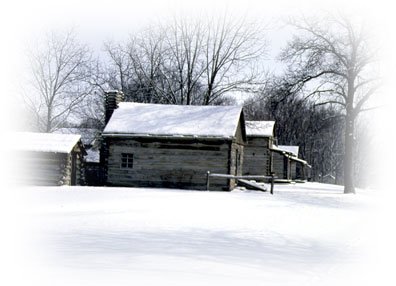
While the village is New Salem’s greatest attraction, most of the site's nearly 700 acres are wooded with about 7 miles of hiking trails, picnic areas, a boat ramp, playground equipment, and a farm lease program. The campground contains eighty electrified and eighty primitive campsites. Two toilet-shower facilities are located in the campground area.
What to expect when visiting Lincoln’s New Salem
Most days the site is open, especially May through October; visitors will meet volunteer and staff historic interpreters demonstrating period activities and engaging about 19th-century life and Abraham Lincoln’s New Salem experience. Visits are typically self-guided walking tours throughout the historic village and the 23 log buildings.
Volunteering
Become a part of the Lincoln story at New Salem!
You are invited to join the volunteer family at Lincoln's New Salem State Historic Site. There are several opportunities to serve:
Historic Interpreter
Historic interpreters wear period clothing in our reconstructed village and interact with visitors from all over the world. Interpreters are educated on the history and significance of the site and trained on how to engage with visitors. Interpreters can pursue a variety of period tasks and skills. No experience is needed!
Visitor Center Services
The Visitor Center Desk is the first impression for many of our visitors. Visitor Center staff greet and orient visitors and groups to the site, operate the orientation film, answer phones, and provide general information about other sites and local amenities. Service at the Visitor Center does not require wearing period clothing.
Support Services
There are also several "behind the scenes" opportunities to serve at the site. Support services include mending and making period clothing, cleaning and assisting in the care of historic buildings and collections, general cleanup, light trail maintenance, and limited clerical work.
Please email DNR.NewSalem@illinois.gov or call 217-632-4000 to set up a time to visit the site and discuss service opportunities. Volunteer training is delivered through both formal sessions led by site staff and experienced volunteers and "hands-on" mentoring by shadowing experienced volunteers, guided readings, and ongoing experiential learning options. You will receive your training progressively and on an individual basis. All training materials are provided, including historical clothing.
Abraham Lincoln—A Notable Figure
Lincoln described himself to his friend Jesse Fell on February 11, 1860, using these words: “If any personal description of me is thought desirable, it may be said I am, in height, six feet, four inches, nearly; lean in flesh, weighing on an average one hundred and eighty pounds; dark complexion, with coarse black hair, and grey eyes—no other marks or brands recollected.”
New Salem was reconstructed because Lincoln spent six years (1831-37) living in the community. He came to town at age 22, having just left his father’s household, and he began his life in the community by working as an unskilled laborer and store clerk for Denton Offutt. Lincoln volunteered for service in the Black Hawk War in the spring and summer of 1832. Returning from the war in mid-summer, he began his political career by running for state legislature but was defeated. Shortly after his defeat, Lincoln went into the store business with William F. Berry, a partnership that failed, leaving Lincoln in debt. In Lincoln’s own words, the store “winked out.” (Scripps, 1860)
Lincoln was appointed New Salem’s postmaster in 1833, a position that he held until 1836, and he became deputy surveyor of Sangamon County in 1834. That year, he ran a second time for the state legislature and won. He was reelected in 1836 and again in 1838. Lincoln also spent time at New Salem preparing to become an attorney by reading law books, some of them borrowed from the Springfield office of lawyer John Todd Stuart. He took his final step to becoming a lawyer on March 1, 1837, when his name was entered on the official roll of attorneys kept by the clerk of the Illinois Supreme Court. He left New Salem on April 15, 1837, to begin a new chapter of life in Springfield.
Abraham Lincoln, future 16th president, lived here from 1831 to 1837 and was a captain in the Black Hawk War, storekeeper, postmaster, surveyor, railsplitter, legislator, and eventually lawyer. Abraham Lincoln would leave New Salem on April 15, 1837, for Springfield, Illinois.
After Lincoln’s departure, New Salem seemed to become abandoned as more residents left for other towns and adventures. Interest in Lincoln’s New Salem was rekindled in 1865 after Lincoln’s death. Historians and biographers, notably William Herndon (Lincoln’s last law partner), started collecting memories and stories from original residents and neighbors of Abraham Lincoln.
These stories and interest in the abandoned village were ever present in the early 1900s when William Randolph Hearst purchased the village land and deeded it to the Old Salem Chautauqua Association. In 1919, the State of Illinois took over ownership of the land.
It is important for visitors to understand that most of what is known—or what we think we know—about the historic New Salem comes from the memories of residents, recorded years after the village disappeared. The most important of this material was gathered beginning in 1865 by William H. Herndon, Lincoln’s last law partner, and published in 1998 as "Herndon’s Informants: Letters, Interviews, and Statements about Abraham Lincoln." In 1902, Thompson G. Onstot, whose earliest memories were of the village, published "Pioneers of Menard and Mason Counties: Made Up of Personal Reminiscences of an Early Life in Menard County." In the 1890s, college student Thomas P. Reep collected the memories of surviving old settlers, which finally saw light in 1918, expanded and published in 1927 as Lincoln at New Salem. In addition, Benjamin Thomas first published Lincoln’s New Salem in 1934. Copies of these important books about the historic village of New Salem can be borrowed from the site library.
The traditional sources are supplemented by some surviving 1830s letters, legal documents, family genealogical records, and newspaper articles.
- All parking lots at Lincoln’s New Salem State Historic Site are paved asphalt.
- In the historic village, the main walkways are sealed stone, rock, and asphalt that are accessible. Only the following buildings in the Historic Village are wheelchair/mobility scooter accessible: Onstot Copper Shop, Lincoln-Berry Store, The Rutledge Tavern, and Waddell's Home.
- Lincoln's New Salem State Historic Site offers three accessible campsites: site 67 (non-electric), site 57 (50-amp), and site 145 (30-amp). All campsites are asphalt and on even ground. Sites are available for reservation. Visit ExploreMoreIL™ for more details.
- Shower Houses—The shower houses offer accessible shower stalls for both genders. There are two shower houses located in the front and back of the campground.
- All visits at Lincoln’s New Salem State Historic Site are self-guided tours. Most visitors spend approximately two hours visiting. There are benches placed throughout the historic village to accommodate those who need a break if needed.
- The distance to the end of the historic village at Lincoln’s New Salem and back to the Visitor Center is approximately one mile in length.
Accessibility Information
The following are available for the visitor to the site:

NOTE ANDROID USERS ONLY: The donation payment processing function in the Illinois History mobile application for Android devices is currently down. Donations are still being processed through the web site at https://dnrhistoric.illinois.gov/experience/sites.html. We apologize for the inconvenience.